
Polk County Parole Versus Probation
Parole and probation can both require reporting and compliance, but they begin in different ways. The Texas Board of Pardons and Paroles decides whether an eligible state prisoner may leave confinement on parole or mandatory supervision. The TDCJ Parole Division then supervises that person. Probation, formally called community supervision in Texas, begins with a court order. Polk County cases are served by the 258th/411th Judicial District Community Supervision and Corrections Department, often shortened to CSCD.
A Polk County Jail release does not answer which form of supervision applies. Bond can end the jail stay while the charge remains pending, with no parole involved. A court may impose probation without a state-prison release. By contrast, someone released from Allan B. Polunsky Unit on parole remains under TDCJ authority. The sentence and release document are the best starting points.
| Question | Parole | Probation |
|---|---|---|
| How it begins | Board-approved release from state prison | Sentence or order from a trial court |
| Who supervises | TDCJ Parole Division | 258th/411th Judicial District CSCD |
| Best proof | Release certificate, IVSS status, or TDCJ confirmation | Sentencing docket and permitted CSCD confirmation |
| How it ends | Discharge, revocation, or completion under state law | Court-ordered completion, discharge, modification, or revocation |
- Parole
- Conditional release from prison before the sentence fully expires.
- Probation
- Court-ordered supervision in the community, also called community supervision.
- Mandatory supervision
- A distinct TDCJ release process based on calendar time, good conduct time, eligibility, and Board review where required.
- Discharge
- Formal completion of a sentence or supervision term.
Verify Polk County Release Supervision
Start with the custody and case history, not a guess based on where the person lives. TDCJ's public inmate search contains only people currently incarcerated in TDCJ. A person who leaves that search may have been released, transferred, or affected by a reporting lag. TDCJ IVSS, a release certificate, and official telephone channels are better post-release sources when parole or mandatory supervision is plausible.
- Identify whether the case involved Polk County Jail, a TDCJ prison, or only a court sentence to community supervision.
- For a prison case, check IVSS and the Board's status information. A favorable vote is not proof that physical release occurred.
- After favorable action, use the TDCJ Parole Division release-status line or request the release certificate. Read the release type and conditions.
- For probation, locate the sentencing docket and confirm that community supervision was ordered. Then contact the local CSCD where disclosure is permitted.
- Match names with a date of birth, TDCJ or SID number, and cause number when available. Similar names can point to the wrong person.
Each source answers a narrow question. A Board result reports a decision. A certificate documents an actual release and its rules. IVSS can report TDCJ custody, parole, or mandatory-supervision status. A court docket records the sentence, while the probation office administers it. None serves as a full archive of every person released from Polk County Jail.
The official county-to-parole-office cross-reference shows how TDCJ assigns Polk County. The image below records that official routing source.
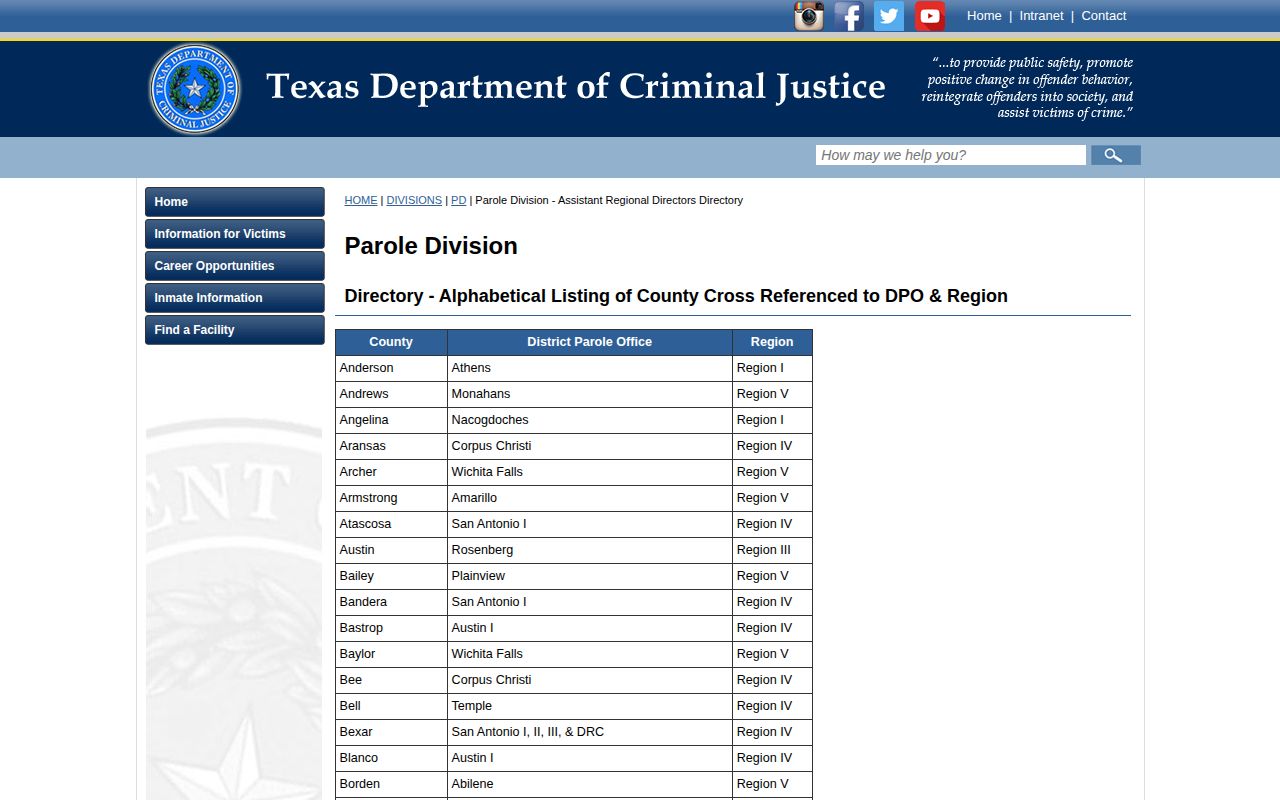
The assignment identifies the office serving Polk County. It does not, by itself, prove that a named person is actively supervised there.
Polk County Supervision Offices
Polk County has one local route for probation and a separate state route for parole. The Adult Probation office is part of the 258th/411th Judicial District CSCD. Its client reporting system requires registration information from the office. It is not a public name search and should not be presented as one.
Polk County Adult Probation
258th/411th Judicial District CSCD
1102 Martin Luther King Drive
Livingston, TX 77351
Phone: 936-327-6872
Fax: 936-327-6897
State parole for Polk County maps to the Huntsville office in TDCJ Region I. Office assignment is geographic. Active status still requires person-specific confirmation through an authorized source.
Huntsville District Parole Office
TDCJ Parole Division, Region I
600 Interstate Highway 45 North
Huntsville, TX 77320
Phone: 936-295-5217
Fax: 936-435-2603
Simple TDCJ information questions may also go to 936-295-6371 or 800-535-0283 from 8 a.m. to 5 p.m. on weekdays. Before a favorable vote, the Board status line is 844-512-0461. After a vote to release, the Parole Division release-status line is 512-406-5202. Have the TDCJ number, SID, or exact birth date ready.
Polk County Parole Warrants
Release conditions are the rules printed on the certificate and reviewed with the person at release. They can include reporting, approved residence, travel limits, treatment, or other case-specific terms. Probation conditions come from the sentencing court. Because terms differ, a general summary cannot replace the certificate or court order.
A parole warrant may issue after a new charge, an indictment, absconding, or an alleged administrative violation. An absconder is someone alleged to have stopped reporting or left supervision without authorization. The warrant remains active until arrest or withdrawal. Arrest can lead to a revocation process in which the Board may continue, change, or revoke supervision. Revocation means supervision is canceled and custody may resume.
No complete public Texas list of all parole absconders was verified. The TDCJ warrant-notification source explains the official route, while the sex-offender absconder search covers only its defined population. A missing name from that limited source says nothing about other parole warrants.
The official warrant page is shown below as a route to current agency instructions.
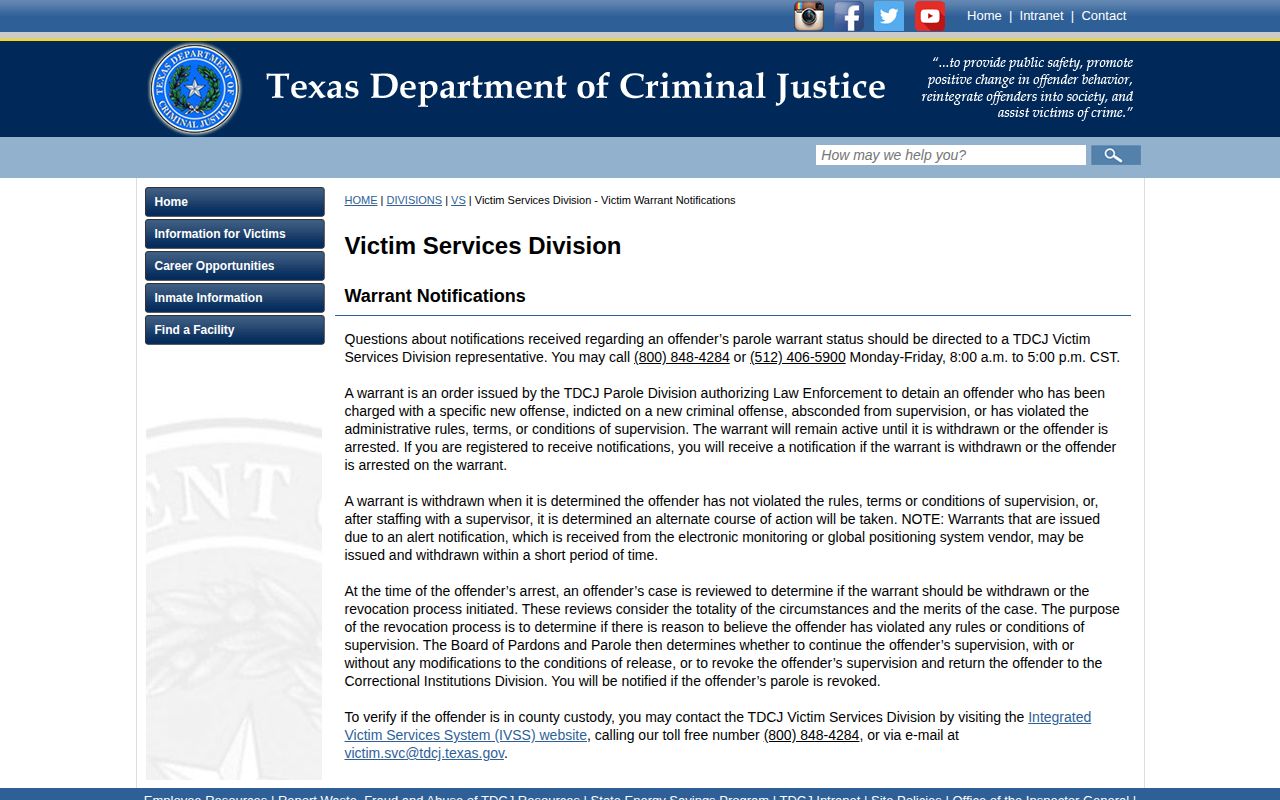
For a specific case, use the supervising authority and official case documents rather than a broad public list.
Polk County Supervision Discharge
Supervision ends through a formal event, not merely because an online result disappears. For parole or mandatory supervision, seek the discharge date or TDCJ discharge record. A release certificate proves the start and terms of supervised release, but it is not the same as proof that supervision later ended. For probation, the court docket may show completion, early discharge, modification, or revocation.
Texas Government Code chapter 508 governs parole and mandatory supervision. The correct rule depends on the offense, offense date, sentence, eligibility, and Board action. Good conduct time affects certain eligibility calculations but does not rewrite the sentence imposed by the court. A person can also complete prison confinement while another valid detainer or authority continues custody.
The Polk County released archive serves a different purpose. It records the end of a Polk jail booking, including transfers. The full county-jail release path and release-record fields are covered on the Polk County released inmates search. Read How Released and Release Reason before linking that event to parole or probation.
Note: A jail release, favorable Board vote, VINE alert, or missing roster entry does not alone establish active supervision or final discharge.
Which Polk Supervision Office?
Polk's office split is a key local fact. The 258th/411th Judicial District CSCD handles court-ordered probation. The Huntsville District Parole Office handles TDCJ parole assignments for Polk County. A Livingston address does not turn a parole case into local probation, and a Polk conviction does not prove the person reports to Adult Probation.
Read the sentence first. “Community supervision” in a court judgment points to CSCD. “Parole” or “mandatory supervision” on a TDCJ certificate points to the Parole Division. If the person only left Polk County Jail on bond, check the court docket for later supervision orders. If the release reason says transfer, follow the receiving authority because confinement continued.
This distinction prevents two common errors: treating every release as parole and treating a client reporting portal as a public status database. Both systems protect some person-specific information, so ask only for information the office can lawfully provide.